AI in Space: Who Is Building It and When
▶ Read as storyGoogle just ran AI in space, and the answer came back as a haiku. You commented ORBIT, so here is the one-page map: who is putting what in space, when it flies, and what has to go right first.
The poem that came back from orbit
01 / What happened
On October 30, Sundar Pichai posted the news. Google sent a command to its Project Suncatcher satellite, booted up one of its own AI chips, ran a prompt and got a complete answer back on Earth.
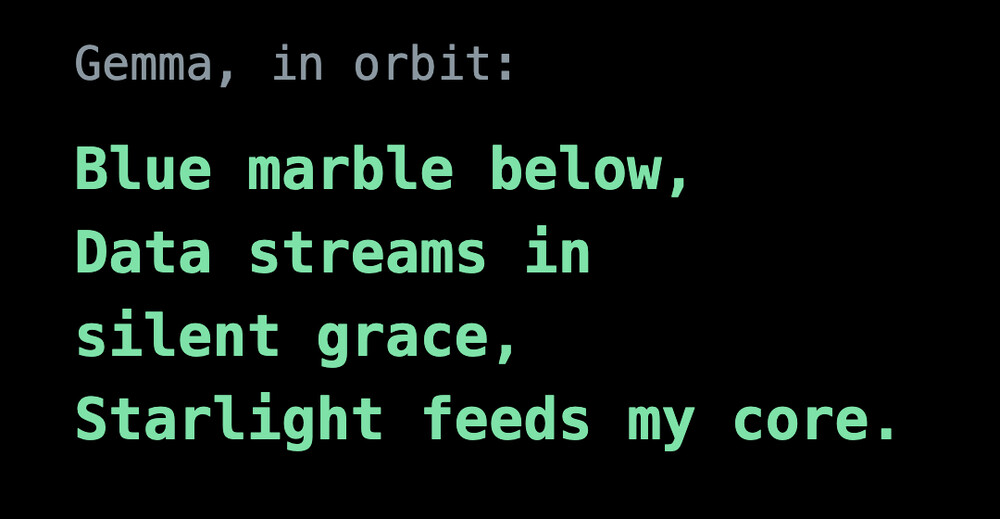
The answer Gemma sent back from orbit. Words from Google’s demo.
- The hardware. Four Trillium TPUs, Google’s own AI chips, on a prototype built with Planet.
- The model. Gemma, Google’s open model, running on the satellite itself.
- The ride. SpaceX Transporter-18, launched October 1.
Why anyone wants AI in orbit
02 / The power ceiling
Elon Musk put it this way: “the output of chips is growing pretty much exponentially, but the output of electricity is flat.”
TrendForce forecasts 491 GW of data center demand by 2030, against 223 GW of grid capacity available to them. That gap of 268 GW is about 270 nuclear reactors.
Space answers that with the biggest power source we have. Google says the Sun puts out more than 100 trillion times humanity’s total electricity, and that in the right orbit a solar panel can be up to 8 times more productive than on Earth.
Who is putting what in space
03 / The map
| Who | What | When |
|---|---|---|
| Project Suncatcher. First prototype flying now | Two more satellites in 2027, to test laser links | |
| SpaceX | Filed for up to 1 million data center satellites | AI compute satellites planned for 2027 |
| Blue Origin | Filed for 51,600 data center satellites, Project Sunrise | Deployment slated for late 2027 |
| Starcloud | Nvidia-backed. Flew an Nvidia H100 on a test satellite | In orbit since 2025 |
| Cowboy Space | Applied to the FCC for a 20,000 satellite constellation | Not announced |
| Rocket Lab | Building the Neutron rocket for this market | Not announced |
When it matters
04 / The dates they gave
The people building this mostly disagree on one thing: the date.
- Elon Musk, X, October 31. “Orbital compute deployed per month probably exceeds terrestrial around the end of 2028 and then far exceeds it in 2029.”
- Sundar Pichai, Fox News. “A decade or so away we’ll be viewing it as a more normal way to build data centers.”
- Jeff Bezos, CNBC. Calls it “very realistic”, and two or three years “probably a little ambitious”.
- Sam Altman, The Indian Express, February. “I honestly think the idea with the current landscape of putting data centers in space is ridiculous. It will make sense someday.” He adds that it won’t matter at scale this decade.
What has to go right first
05 / Three things to watch
1. Rockets have to get far cheaper. Google’s paper in Joule expects launch prices near $200 a kilogram by about 2035. TechCrunch works that out to about 1,800 Starship launches in 10 years, or 180 a year. Starship reached orbit for the first time on September 28.
2. The heat has to leave. Space has no air, so heat only leaves through radiators. Elon’s version at Davos: solar panels facing the Sun, “a radiator that’s pointed away from the sun”. The size is the challenge. IEEE Spectrum puts one 40 kW rack at an 80 square meter radiator, about a pickleball court. Google’s chip runs for about 15 minutes at a time, then cools down.
3. Satellites have to work as one computer. Large AI jobs need chips talking constantly, so Google’s plan links satellites with lasers. Its two satellites in 2027 are the test. Repairs are still an open question, which is Altman’s point: nobody can reach a broken chip up there.
Every time AI hits a wall, the wall moves. If you’re betting on AI slowing down, I wouldn’t.
My take
Sources
Where this comes from
- Sundar Pichai on the first response from orbit, X
- Learn about Project Suncatcher, Google
- Exploring a space-based AI infrastructure design, Google Research
- Project Suncatcher’s orbiting TPU delivers its first haiku, Unite.AI
- Google thinks Starship has to launch 1,800 times, TechCrunch
- No one wants AI data centers on Earth. Do they make sense in space?, CNBC
- SpaceX launches Starship into orbit for the first time, CNBC
- Data center power gap of 268 GW by 2030, TrendForce
- Why orbital data centers are harder than Silicon Valley thinks, IEEE Spectrum
- Altman calls space data center plans ridiculous, Fox Business
- Elon Musk’s interview with Dwarkesh Patel and John Collison, Dwarkesh Podcast
- Elon Musk on orbital compute, X
What people asked
Questions
Has Google really run AI in space?
Yes. On October 30, 2026, Google said its Project Suncatcher prototype ran a prompt on one of its TPU chips in orbit and sent back a haiku. It is a test of a single chip, and the first step toward much larger systems.
Why put data centers in space?
Power. Data center demand is forecast to outgrow the grid by 2030, and in the right orbit a solar panel gets near-constant sunlight and can produce up to 8 times more than on Earth.
When will AI data centers in space be real?
The dates vary. Elon Musk says orbit passes Earth for new compute around the end of 2028. Sundar Pichai says a decade or so. Sam Altman says not at scale this decade.
How do you cool a computer in space?
With radiators. There is no air to carry heat away, so satellites face their panels at the Sun and point radiators toward cold space, where the heat leaves as infrared light.