The eMCPation Proclamation
Adobe just set Photoshop and Premiere free for your own AI. That is not a feature launch. It is a signal that software knows it is exposed, and it is moving.
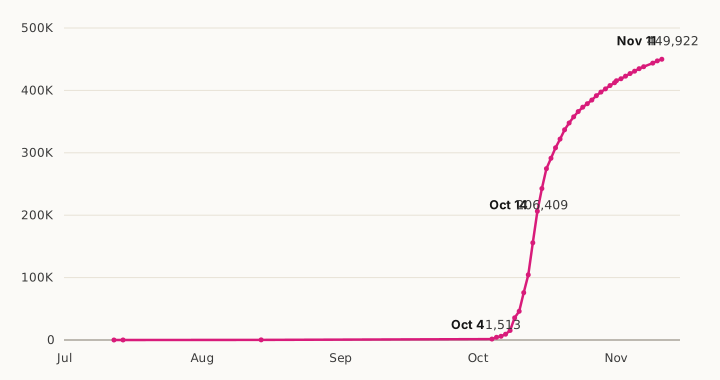
 450KGitHub stars on Reverse Engineer Anything, nearly all since Oct 4
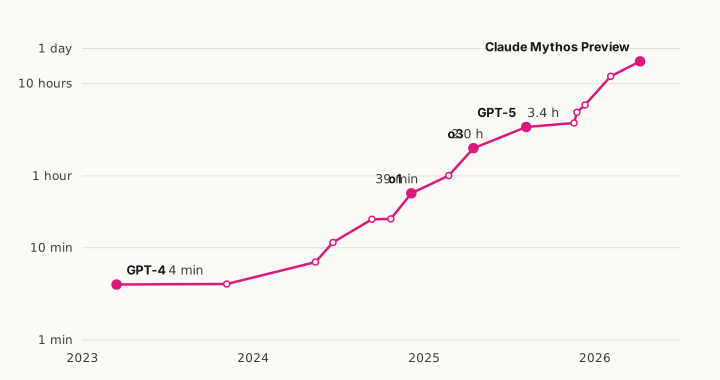
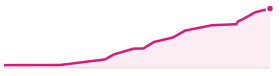 17 hourstask AI finishes alone, up from 4 min in 2023
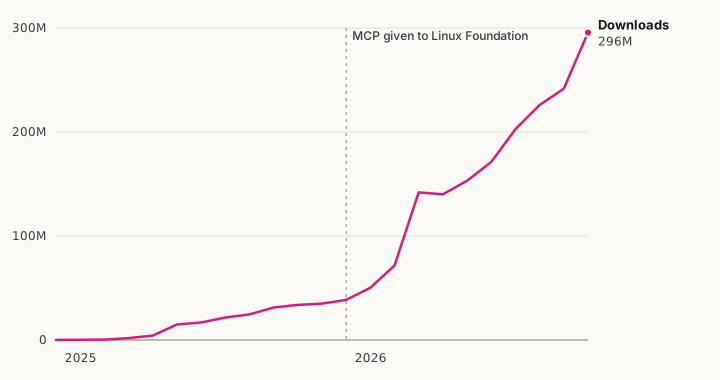
 296MMCP SDK downloads a month, 8.8x in a year
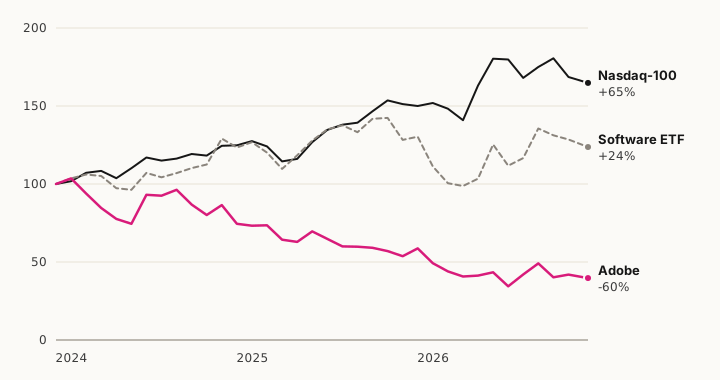
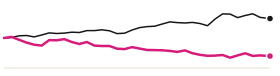 -60%Adobe stock since Dec 2023. Nasdaq-100: +65%
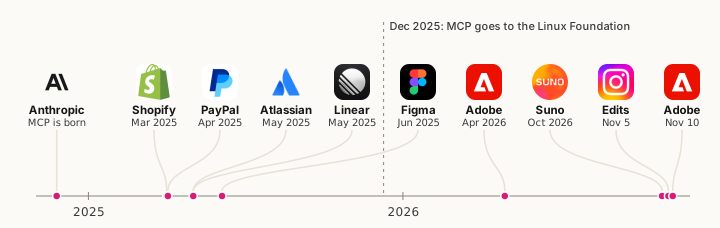
Official MCP launches, two years. Each dot is the company’s own announcement: Anthropic,1 Shopify,2 PayPal,3 Atlassian and Linear,4 Figma,5 Adobe in Claude,6 Suno,7 Instagram Edits,8 Adobe MAX.9
 TechCrunch · Nov 10Adobe brings AI agents and new creative tools to Photoshop, Premiere, and Firefly
 No Film School · Nov 10Adobe MAX 2026: Local MCP Integrations Coming to Creative Cloud Tools (Like Premiere)
 MLQ.ai · Nov 10Adobe previews MCP integrations that let outside AI agents run Photoshop and Premiere
 Digital Today · Nov 11Adobe adds AI features across Photoshop, Premiere and Firefly, unveils MCP
TechCrunch · Nov 5Instagram brings Edits to desktop to take on CapCut
 CNBC · Apr 9AI threat's relentless flogging of software stocks shows no end in sight with Anthropic's new agent
Adobe, the company that taught the whole industry to rent you software forever, just told your AI to come on in.
Your own agent, ChatGPT, Claude or Gemini, working inside your real Photoshop or Premiere files, with layers, sequences and compositions still editable when it is done.9 Adobe’s VP Deepa Subramaniam told TechCrunch: “We don’t have any need or desire to sort of limit what the MCP endpoint can expose.”11
The same day, I posted a short video asking why so many companies are suddenly shipping official MCPs. Adobe is the best answer I could have asked for. Here is the longer version, with the numbers behind it.
The signal
Companies do not open up because they feel generous. They open up when they smell that they are exposed.
For years “AI agents will replace apps” was a theory people argued about on podcasts. When the most guarded company in creative software hands your AI the keys to Photoshop, it stops being a theory. The people who see the usage numbers every morning decided they have to move now, or get washed away by the wave.
Call it the eMCPation Proclamation, and Adobe just read it out loud. The buttons that were locked inside each app are being set free, one MCP at a time, and so are we.
My thesis in one line: the models can now rebuild almost any app, so the interface is no longer the moat, so the winners are the people who build their own workflows, either on top of these products or fully their own.
The old deal
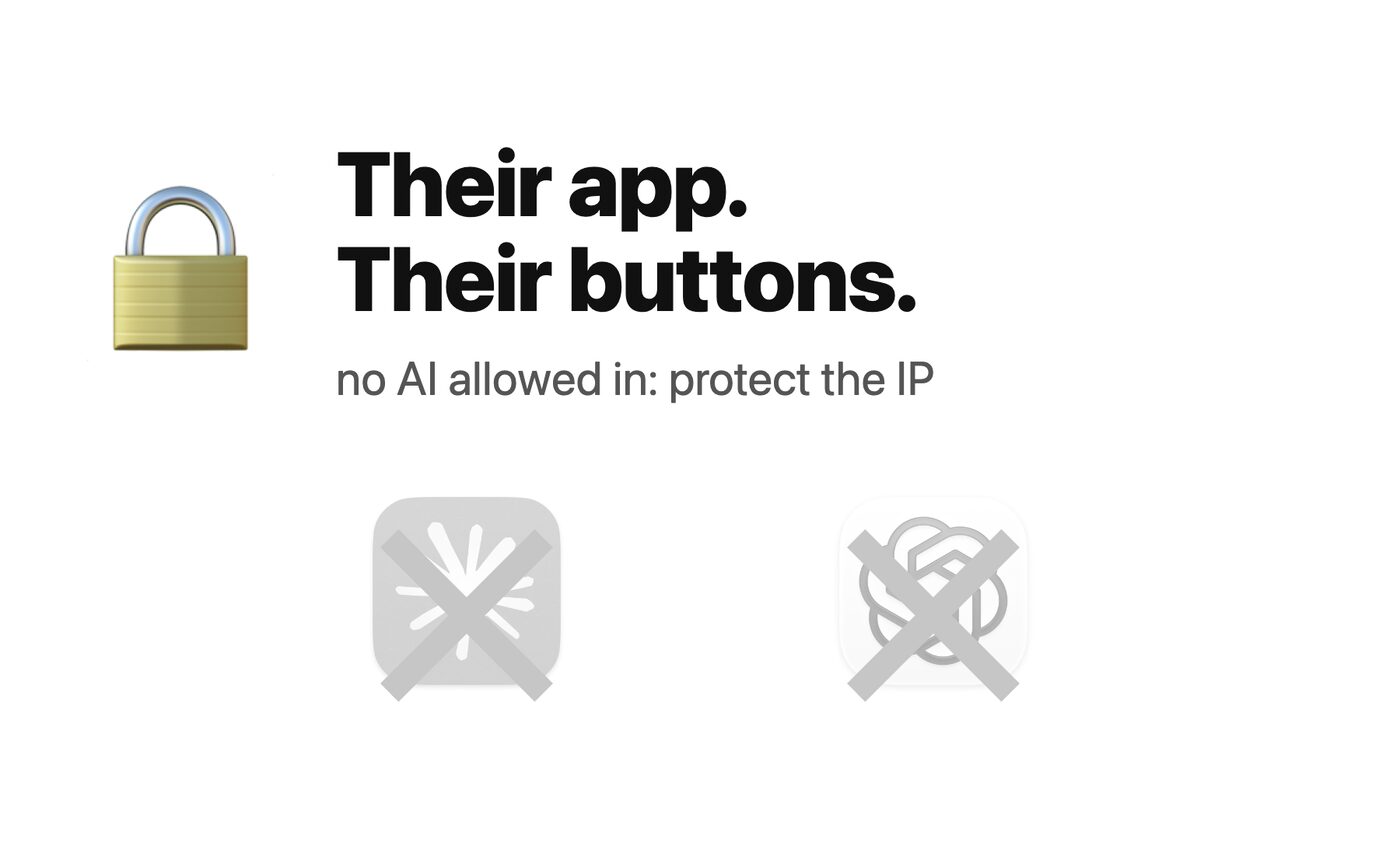
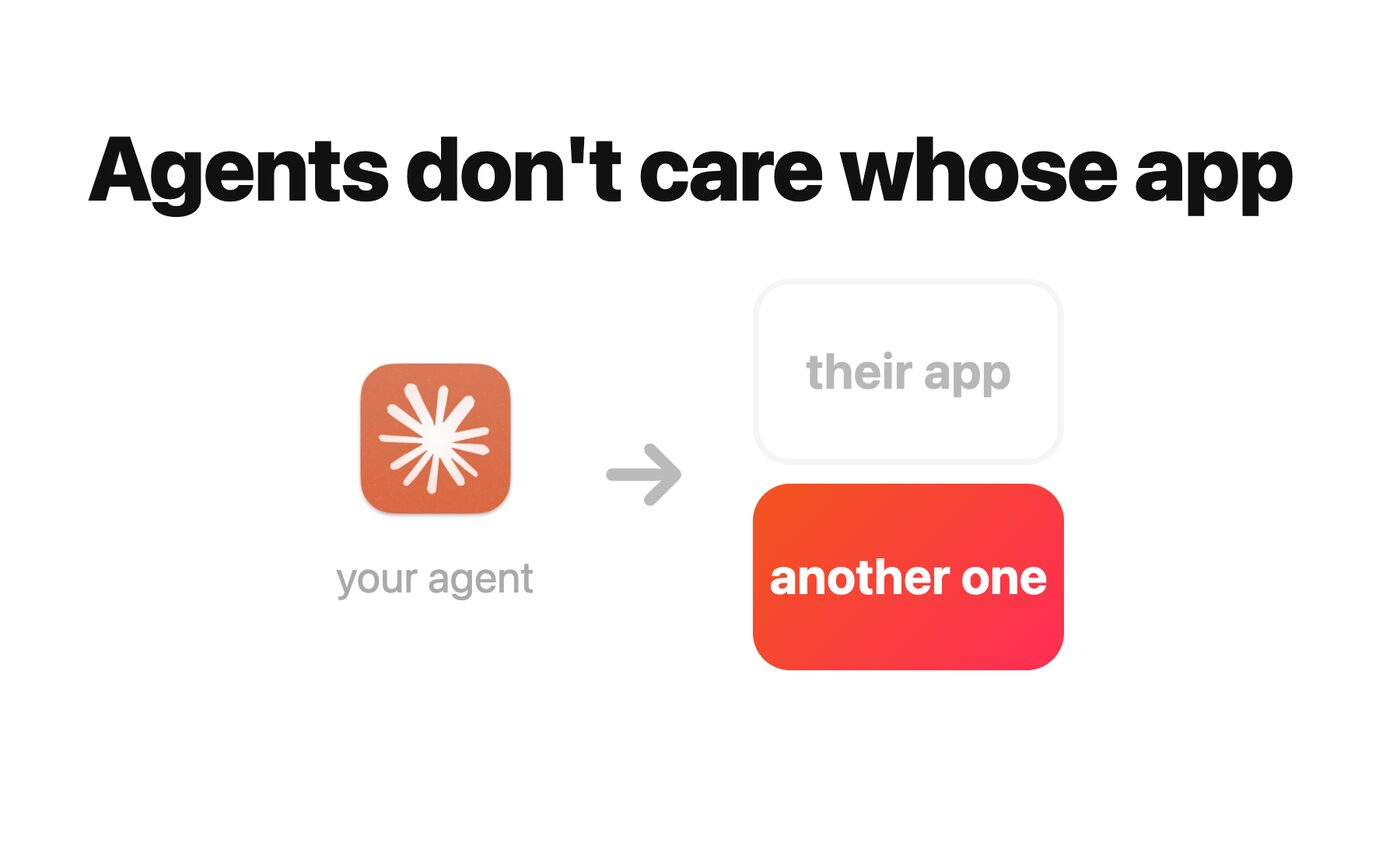
For most of software history the interface was the product. You opened their app, clicked their buttons, learned their menus, and that learning was the lock. Leaving meant learning someone else’s buttons.
So companies kept AI out. Protect the IP, protect the screen. If an agent can use your product, the agent can also decide to use a different one.
The models can now rebuild almost anything
Under all of this sits one cause. The models got good enough to take software apart and put it back together.
METR measures how long a task an AI agent can finish on its own, timed by how long the same task takes a human expert. GPT-4 managed about 4 minutes in March 2023. Claude Mythos Preview managed about 17 hours in April 2026. That is 262 times longer in three years, doubling roughly every four months.12
That is what makes reverse engineering cheap, and developers noticed. REA, short for Reverse Engineer Anything, is one MCP that lets an agent take apart an app’s behavior down to its native binaries. Its pitch: “See a feature you like. Understand how it works, down to the binary level.” It sat at a few hundred GitHub stars for months, then went from 1,513 on October 4 to 206,409 ten days later. Today it has 450,377, the fifth most-starred repository on all of GitHub and the most-starred one created this year.13
The classic tools went the same way. Ghidra and IDA Pro, the two standard programs for taking compiled software apart, both got MCP plugins in March 2025, and those two plugins have more than 25,000 stars between them.14
I do the same on smaller things. Song Exploder takes any song apart into stems, MIDI and drum patterns, rebuilds the beat and grades itself against the original. SFX Exploder pulls every sound effect out of other creators’ shorts. In the last few weeks I also built my own ManyChat for Instagram comments, my own silence cutter, a free voice cleaner that does on my Mac what Adobe’s Enhance Speech does in the cloud, and a voice changer that runs locally. None of them has a polished interface. All of them do exactly the job I need.
Add open source on top. A popular paid app now gets an open copy within weeks, and your AI can install it, fix it and wire it to everything else you use. That is what the companies are racing.
The wave is measurable
Then the work started moving to the agent. You stop opening the app. You ask your AI, and it does the job wherever it can. An app that gets opened less is an app that gets cancelled.
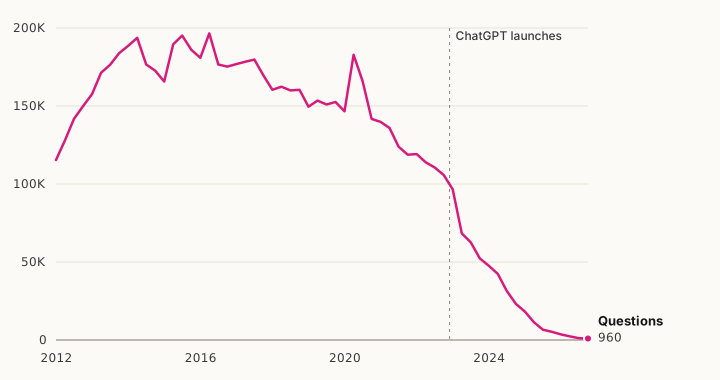
You can watch it happen to a product. Stack Overflow was where every developer went for answers. New questions peaked near 200,000 a month. In October 2026 people asked 960.15 Nobody switched to a better Stack Overflow. They stopped needing to go.
Investors are pricing in the same thing. Early 2026 was brutal for software stocks. By April 9 the main software ETF (IGV) was more than 35% off its high, and one analyst counted “$1.4T in SaaS market cap” lost.16 Adobe is down 60% since the end of 2023, while the Nasdaq-100 is up 65%. Not all of that is AI agents, but the market is asking the same question I am.
And the people running these companies say it themselves. Satya Nadella on the BG2 podcast: “the notion that business applications exist, that’s probably where they’ll all collapse, right in the agent era.” Then: “Hey, why do I need Excel?”17 Microsoft makes Excel.
So they hand over the buttons
An MCP (Model Context Protocol) is a plug between a product and an AI. Anthropic open-sourced it in November 2024 as “a new standard for connecting AI assistants to the systems where data lives.”1 You sign in once, and your AI can do what you used to do by clicking around the interface.
Two years later it is the default. By December 2025 it was in ChatGPT, Gemini, Microsoft Copilot and VS Code, with more than 10,000 active public servers, and Anthropic handed it to the Linux Foundation so no single company owns it.18 The download count for the official toolkit tells the rest.
Then the products followed, each with its own announcement. The launch chart at the top has every one, linked to its source.
This is defense. If the work happens in your AI anyway, the best a product can do is be so easy to use from your AI that you never leave, and never build your own.
On top, or fully yours
There are two ways to build your own workflow now, and both are easy enough to start this week.
Build on top. Keep the product, skip its interface. Connect its MCP to your AI and chain it with everything else: record in one app, cut in another, add music from a third, post, all in one ask. You get the engine they spent years on, with buttons you designed yourself.
Own it outright. When a product does one simple thing you use every day, ask your AI to build that thing for you. No subscription, no seat limits, no waiting for their roadmap.
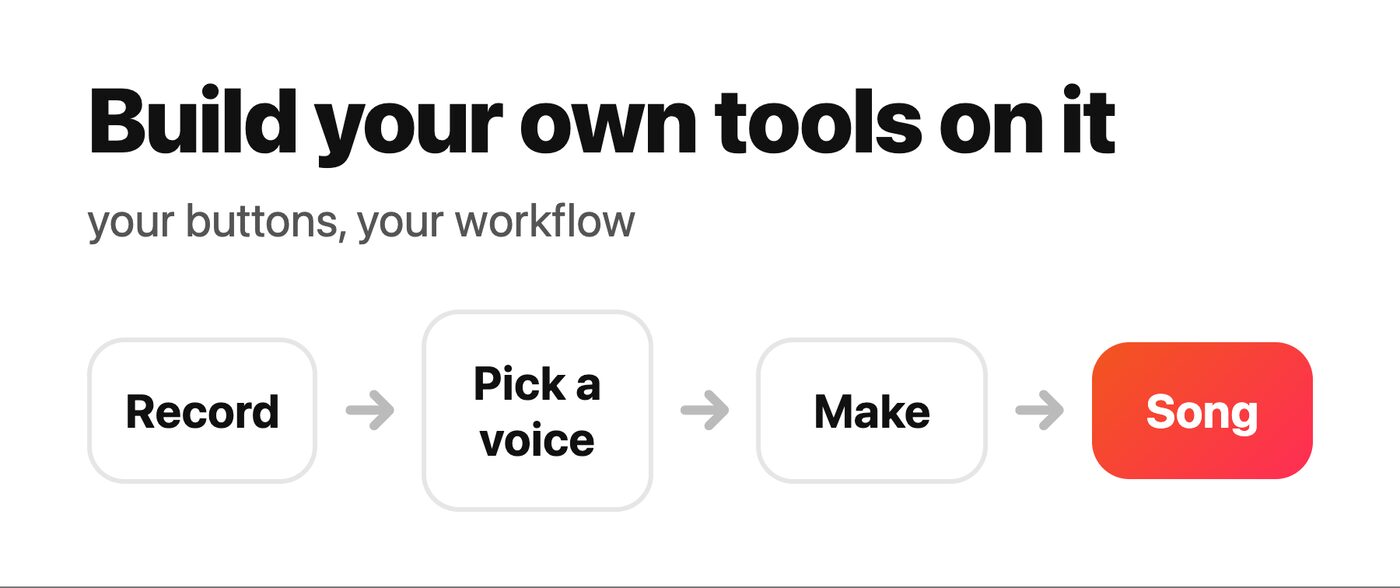
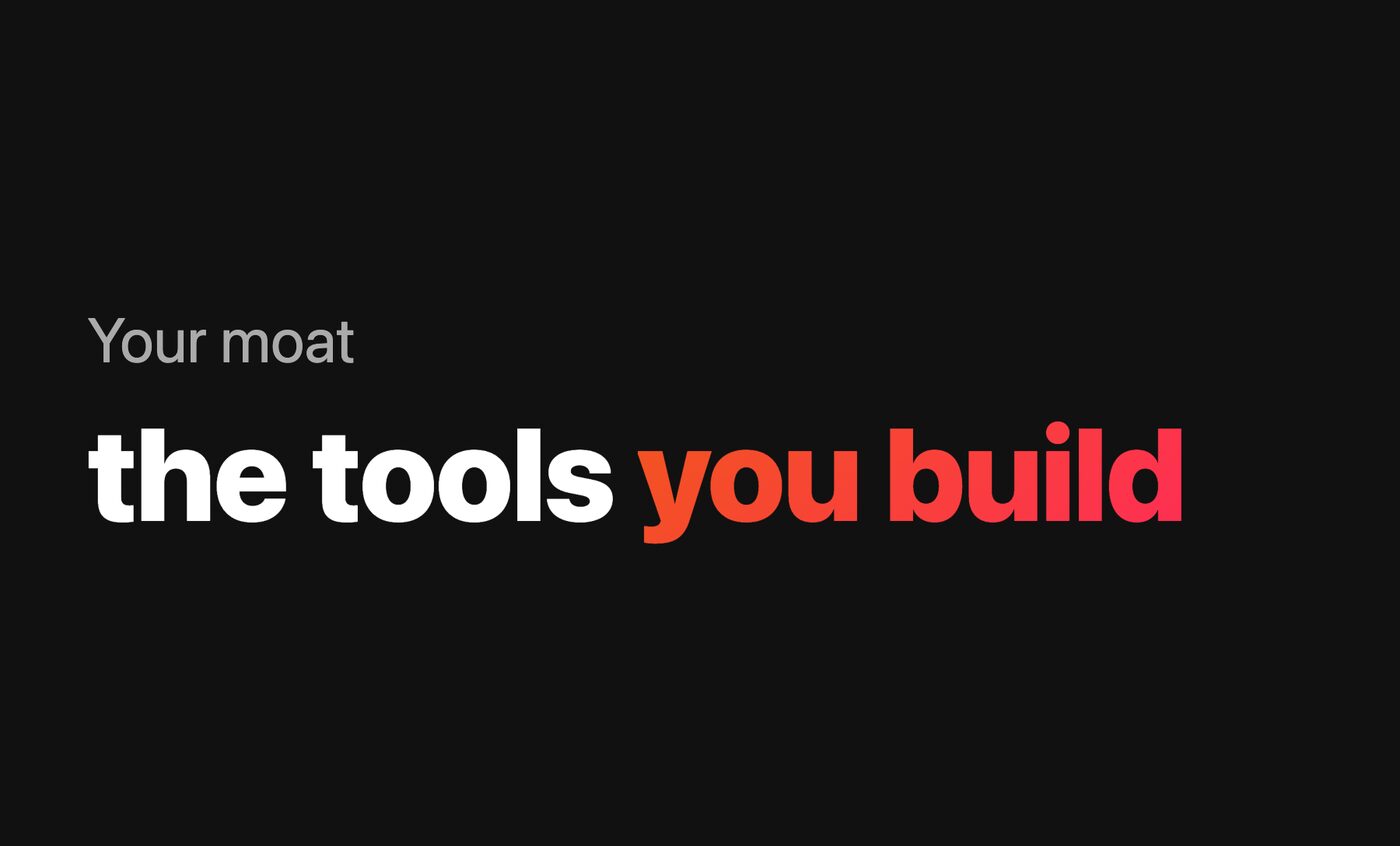
Why bother? Because it has never been this easy. You describe what you want in plain words, your AI builds it, and you can read and change every step. You do not need to be technical. You need to know your own work better than the software company does, and you already do.
What is left when the buttons are free
An MCP splits a product in two: the part you click, and the part that does the work. When every AI can do the clicking, the clicking stops being what you pay for. What stays valuable is the back half:
- The data. What a product knows that nobody else does, and keeps learning every day it runs.
- The engine. The thing that does the work well: the model, the render, the index, the price feed.
- The proof. Results shown over time. Trust that a copy built last weekend does not have yet.
None of those can be built in an afternoon. You earn them, and they compound.
Where I see the opportunity
If you run a business or build software, three places look better to me than they did a year ago:
- Internal tools. Software for your own team. It does not need to be sold, marketed or pretty. It only has to work for the five people who use it, and that is now cheap to build and change every week.
- Non-technical niches. Most people will never open Claude Code. A dentist, a restaurant, a contractor still need software that fits how they work. Whoever understands their world and can build fast wins there.
- Data that builds up over time. Every price you record, every result, every customer question answered. Start collecting now. The tool on top can be rebuilt any time. The history cannot.
If you are a creator or just want more done, hook up everything you can. Every new MCP is another instrument your AI can play. Connect it, then make it play your song.
Is this good or bad?
For you and me, good. The more pressure on the big products, the more freely we get to use them on our own terms. For the companies, it is a race: open up and stay the default, or stay closed and watch the usage drain away like it did at Stack Overflow.
Adobe picked a side yesterday. I expect most of the rest to follow within a year.
Let anyone’s AI press the buttons. Build the part nobody can copy in a weekend.
Footnotes
-
Anthropic, “Introducing the Model Context Protocol”, November 25, 2024. ↩ ↩2
-
Shopify, “Shopify.dev MCP Server”, March 31, 2025. ↩
-
PayPal, “PayPal Begins Rollout of MCP Servers to Accelerate Agentic Commerce”, April 2, 2025. ↩
-
Atlassian, “Introducing Atlassian’s Remote Model Context Protocol (MCP) Server”, May 1, 2025; Linear, “Linear MCP server”, May 1, 2025. ↩
-
Figma, “Introducing our MCP server: Bringing Figma into your workflow”, June 4, 2025. ↩
-
“Adobe for creativity connector for Claude”, No Film School, April 28, 2026. Adobe’s own release says it now has connectors with “Anthropic, OpenAI, Slack and others” (note 1). ↩
-
Suno, “Suno MCP (beta)”, October 28, 2026. ↩
-
“Instagram brings Edits to desktop to take on CapCut”, TechCrunch, November 5, 2026. Tool count from my own Edits 454.0.0 install; the setup is in Edit with AI in Instagram’s free Mac app. ↩
-
Adobe, “Adobe Powers a New Era of Creativity, Bringing Agents and Tools to Creatives Wherever and However They Create”, press release, Miami Beach, November 10, 2026. Also on the Adobe blog. ↩ ↩2 ↩3
-
Adobe blog, November 10, 2026: “MCP integrations are coming to Creative Cloud customers in early 2027.” Same link as note 1. ↩
-
Ivan Mehta, “Adobe adds more AI to its products and launches an MCP”, TechCrunch, November 10, 2026. ↩
-
METR, “Task-Completion Time Horizons of Frontier AI Models”, Time Horizon 1.1, last updated September 8, 2026; raw data. 50% horizons: GPT-4 3.99 minutes, Claude Mythos Preview (early) 1,044.8 minutes. METR’s fitted doubling time for models from 2023 on is 128.7 days. METR notes that a 50% horizon of X hours does not mean you can hand an AI any task under X hours. ↩
-
morluto/rea, created April 14, 2026, MIT license, also on npm as
rea-agents. 450,377 stars and 110,824 forks from the GitHub API on November 11, 2026; rank from GitHub search by stars the same day. Earlier counts are thestargazerCountin each Internet Archive snapshot of the repo page. ↩ -
LaurieWired/GhidraMCP, created March 23, 2025, 11,884 stars; mrexodia/ida-pro-mcp, created March 25, 2025, 13,435 stars. Counts from the GitHub API, November 11, 2026. ↩
-
New questions per month from the Stack Exchange API (
site=stackoverflow,filter=total), first month of each quarter, January 2012 to October 2026, pulled November 11, 2026. Counts questions still on the site, so deleted ones are left out. Highest sample: 196,524 in April 2016. ↩ -
“AI threat’s relentless flogging of software stocks shows no end in sight with Anthropic’s new agent”, CNBC, April 9, 2026. The $1.4T figure is Ben Reitzes of Melius Research. Adobe, QQQ and IGV prices are monthly closes from Yahoo Finance. ↩
-
Kevin Okemwa, “Hey, why do I need Excel?”: Microsoft CEO Satya Nadella foresees a disruptive Agentic AI era, Windows Central, May 9, 2025, quoting the BG2 podcast with Bill Gurley and Brad Gerstner. ↩
-
Anthropic, “Donating the Model Context Protocol and establishing the Agentic AI Foundation”, December 9, 2025: “more than 10,000 active public MCP servers” and “97M+ monthly SDK downloads across Python and TypeScript.” The chart counts the TypeScript package only, from the npm downloads API. ↩
Attachments
- MP4The videoWhy are MCPs hot all of a sudden? 1:53, vertical18.3 MB
- LINKAdobe's MAX 2026 press releaseAdobe, November 10, 2026 (PDF)news.adobe.com
- CSVData: MCP SDK downloads per monthnpm registry, December 2024 to October 20260 KB
- CSVData: Stack Overflow questions per monthStack Exchange API, sampled each quarter, 2012 to 20261 KB
- CSVData: Adobe vs Nasdaq-100 vs software ETFMonthly closes, indexed to 100 at December 20231 KB
- JPGSlide: Your moat is the tools you build30 KB
- PAGEEdit with AI in Instagram's free Mac appThe setup for the Edits MCPsoulepreneur.com